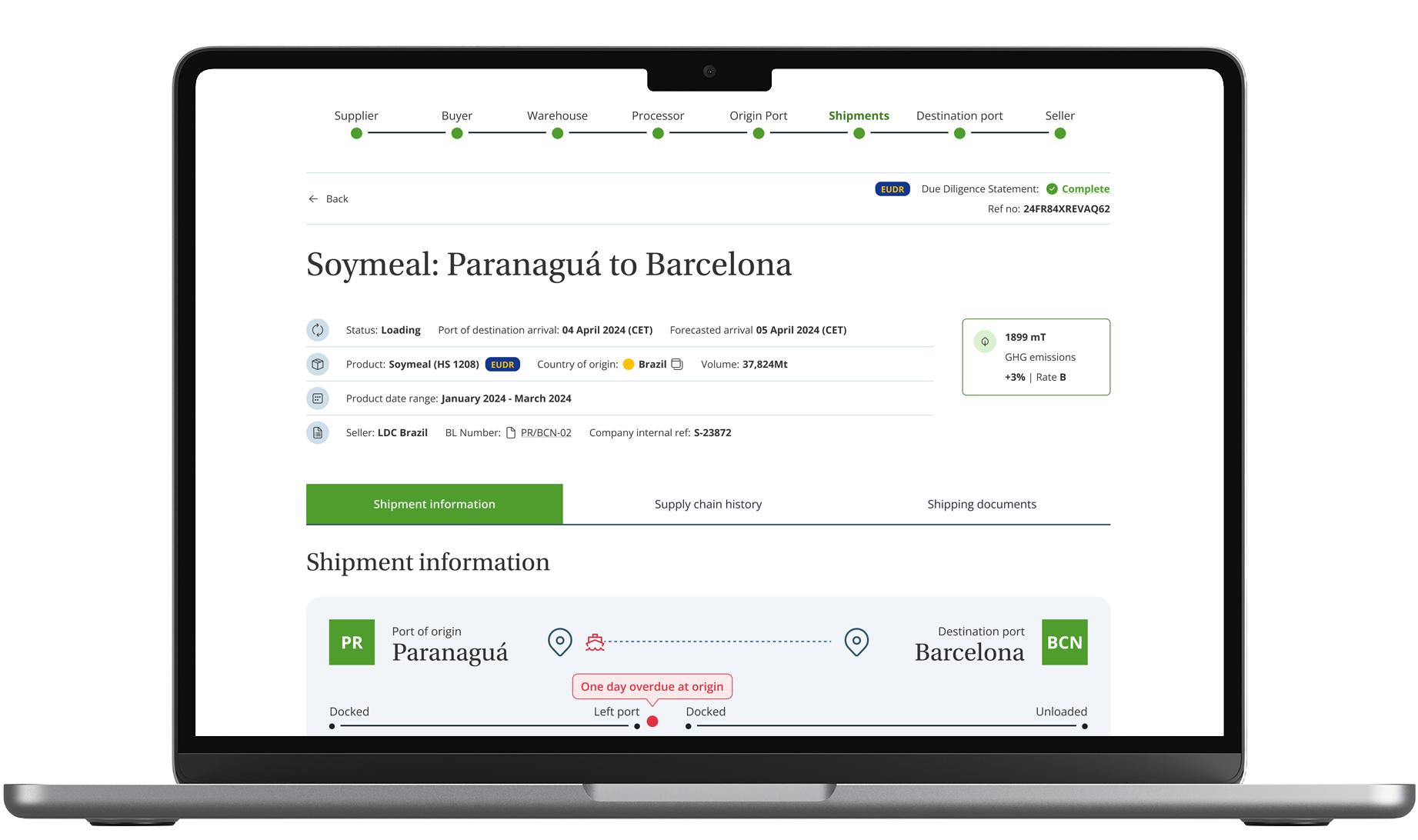

Supply Chain tracking application for deforestation compliance
Service design and experience design lead on a project to help understand how global bulk produce supplier Louis Dreyfus (LDC) could meet upcoming EU deforestation prevention regulation across global supply chains. Understanding and mapping the soybean journey from Brazil to Europe capturing all movements and data held to be able to craft an interface to meet and automate strict EU reporting needs, but flexible enough to deal with huge differences in data availability in different products and countries and allow growth in detail fidelity over time.
Tracing Soybeans (and Coffee) Back to the Farm
Louis Dreyfus Company (LDC), one of the world’s largest bulk agricultural commodity traders - importing and exporting products like soybeans, coffee and palm oil for processing, needed to understand how it could trace every shipment entering Europe back to its farm of origin, along with the environmental impact of getting it there. The driver was the EU Deforestation Regulation (EUDR), which puts the burden on food producers to prove their imports haven’t contributed to deforestation. I led a short, sharp design engagement, delivered by Avanade’s digital studio as part of a larger, ongoing Accenture relationship with LDC, to show them what a system to meet this could look like.
The EUDR requires extensive due diligence and traceability across supply chains for goods entering the EU, proving they’re not linked to deforestation, biodiversity loss, or human and indigenous rights violations. In reality, that evidence sits scattered across disconnected systems and data sources, much of it manual and paper-based. Non-compliance meant real exposure for LDC - multimillion-euro fines, products stuck in ports or turned around on ships, or the loss of import licences into the EU.
The complexity varied enormously by commodity. Soybeans have a relatively mature, consistent supply chain with large, well-documented farms, but even there, once a truckload from one farmer reaches a drying facility, it gets mixed with grain from many other sources, meaning traceability has to work on a time-window basis (how long a hopper takes to fill and empty) rather than a bean-by-bean basis. Coffee sourced from Vietnam was far harder: beans come from thousands of small, largely untracked farmers through third parties and expert coffee tasters deliberately blend piles from different origins to hit a target flavour profile, a brilliant craft, but it destroys origin traceability in the process. It’s exactly this kind of complexity that likely drove the EU to postpone the regulation. On top of that, bulk shipping adds its own risk: LDC’s cargo could be mixed in a ship’s hold with another exporter’s and if that exporter failed to file their own due diligence statement, LDC’s shipment could be blocked at port too.
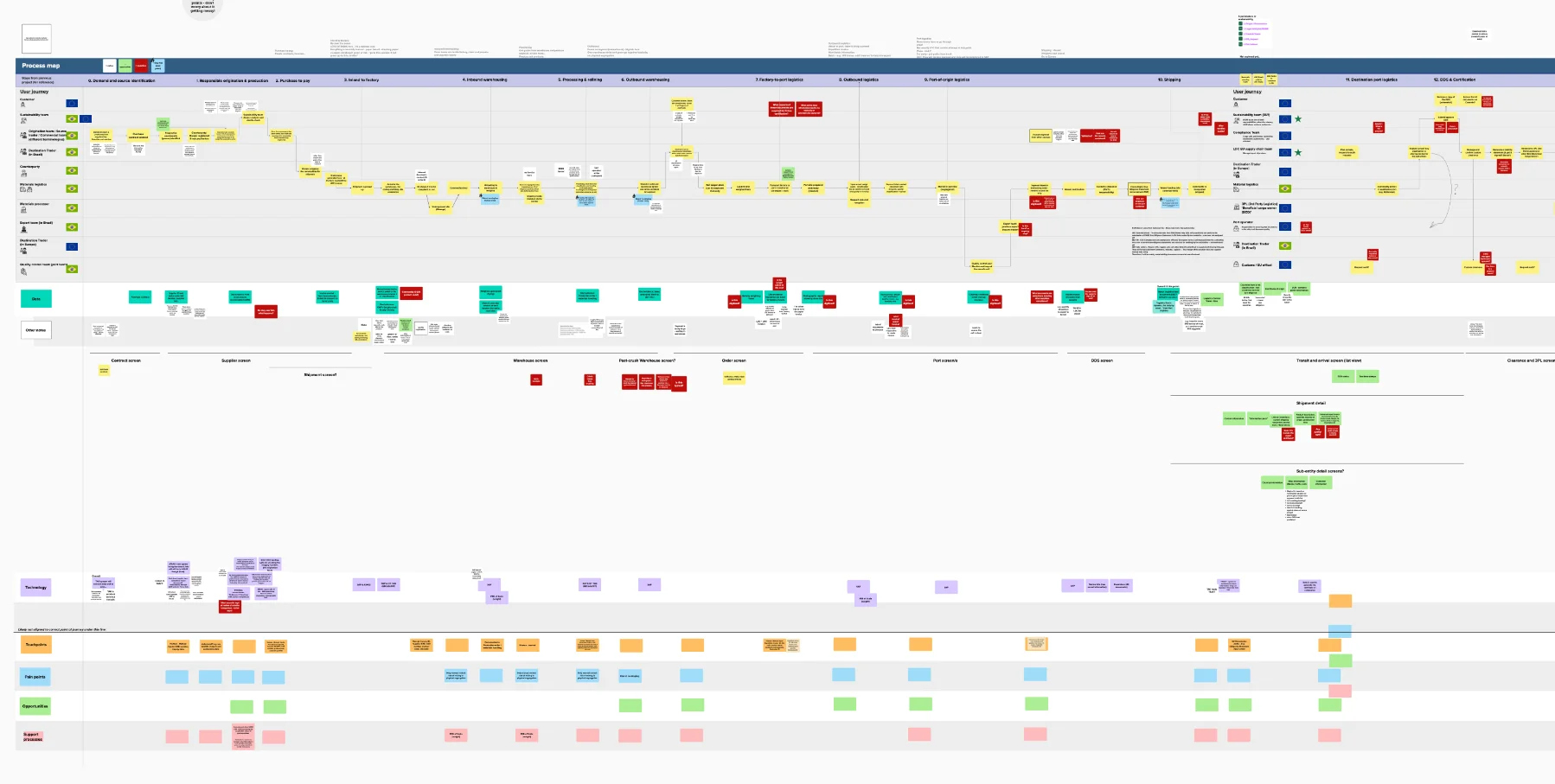
I planned and executed the project: designing, facilitating workshops and research, building the prototype and testing and validating it with LDC stakeholders and a supply chain expert Accenture brought in from the US, someone whose team had spent weeks physically tracking soybeans from origin to port in Brazil, giving us an unusually well-detailed evidence base to design against.
Working from that groundwork, I drove a modular architecture that let LDC plug in whatever quality of data they actually had, rather than requiring every system to be modernised before the tool could be useful at all, letting them build accuracy incrementally over time.
Discover
We went into stakeholder workshops already carrying detailed, field-verified information from the Brazil-based team who’d tracked soybeans from farm to port in person, seen the sites, the paperwork and the systems firsthand. From there, we ran workshops with LDC stakeholders to define the process itself, building a detailed, multi-swim-lane service blueprint covering the full farm-to-EU-import journey. Engagement was inconsistent, with only a handful of people attended regularly, likely reflecting how complex and, at the time, uncertain this whole area felt to the business, but those regulars were enough to properly define the service blueprint, wireframes and testing design.
Design
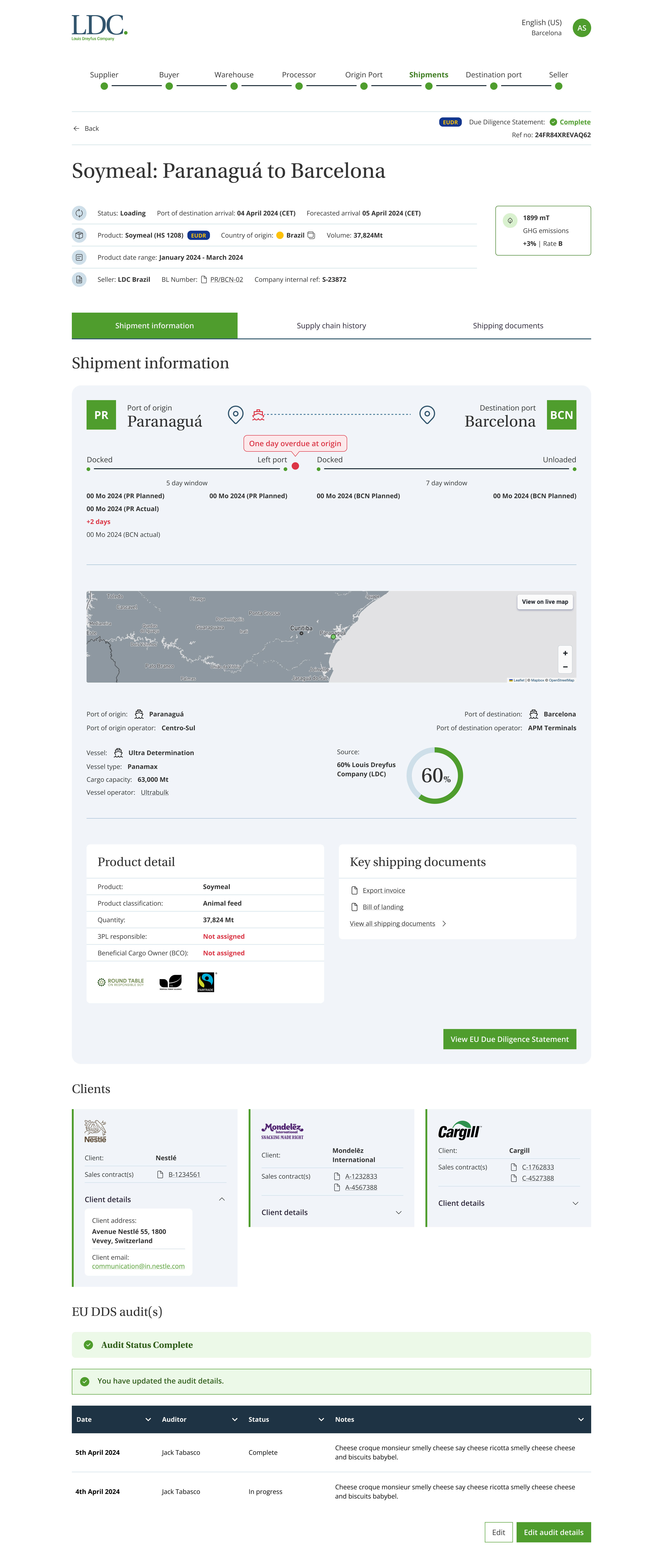
We designed “TAG” (Traceable Agricultural Goods) - a system consolidating shipment data, documents, certifications and farm-level origin data (including satellite imagery, AI-checked for deforestation) into a single source of truth. It shows the full chain back to origin farms, including interactive polygon-level farm maps, checks supporting documents are complete and prompts users when they’re not and gives a live readiness status for EU certification, including the ability to pre-certify a shipment before it even reaches Europe, so it can go straight from ship to truck with no port delay. I deliberately extended the design beyond EUDR specifically, to support any sustainability certification globally to make the system more universally valuable. We also built in careful data masking, so downstream clients get the compliance information they need without LDC exposing individual farmers’ details, while still supporting a full audit trail and analytics for EU auditors.
Deliver
We built a working prototype and a short video aimed squarely at LDC’s C-level executives, the audience who needed to understand both the implications for the business and that a workable system could genuinely be built now, with the data inconsistencies they already had. The video walked through a real-world scenario: a Brazil-based supply chain manager reviewing a soy meal shipment heading to Spain for Nestlé, filtering and drilling into origin port, destination, commodity type, vessel details and attached sustainability certificates, showing the tool as a genuine operational instrument for supply chain and compliance staff to monitor shipments, flag incomplete declarations, assemble statements and share only the compliance-relevant data downstream.
LDC came away able to see, concretely, the traceability problems their inconsistent supply chains were going to create, and, just as importantly, that a usable, modular system existed that could start ingesting both manual and automated data immediately, regardless of whether or when EUDR eventually came into force.
For C-level executives, the video distilled the whole problem and solution into a few minutes: real regulatory compliance at scale, turning what would otherwise be a fragmented, manual due-diligence exercise into something the system does most of automatically. One consolidated system replaces manual cross-referencing across scattered data sources and gives LDC, their clients and EU auditors a shared, trustworthy view of compliance, without exposing anything commercially sensitive. Strategically, it also positions LDC to demonstrate broader sustainability leadership in agricultural trading, turning a regulatory obligation into a genuine reporting and reputation advantage with investors, customers and origin communities.
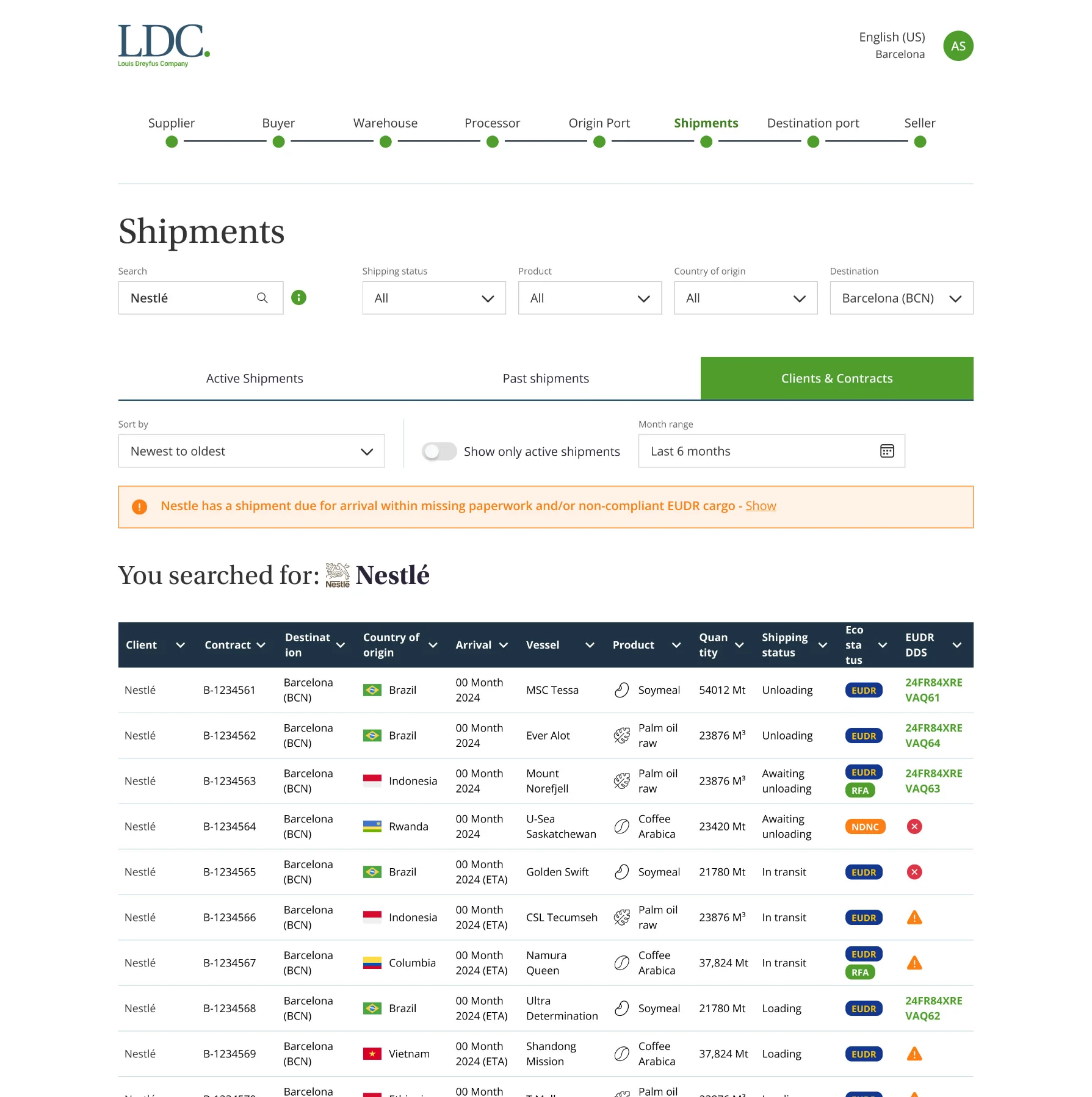
This was another case of turning complex, inconsistent business reality into something consolidated and genuinely usable, in a very short window - always hard, given how quickly you have to understand the domain, get stakeholders aligned and produce something worth their time to review. Even with only two or three regulars in the workshops, the resulting video landed well: LDC seemed genuinely surprised by both the depth of insight and the simplicity of the solution - this didn’t look like a CRM or a generic tracking system, it looked like a simple, powerful way to actually understand compliance and analytics.
More than anything, this reinforced how much service design and service blueprinting matter here. You can only really start designing once you understand the end-to-end process - there’s no shortcut to jumping into screens before you’ve properly understood the business, the desired outcome and everything shaping how a design will work.