
Reinventing energy trading for a renewable-first future
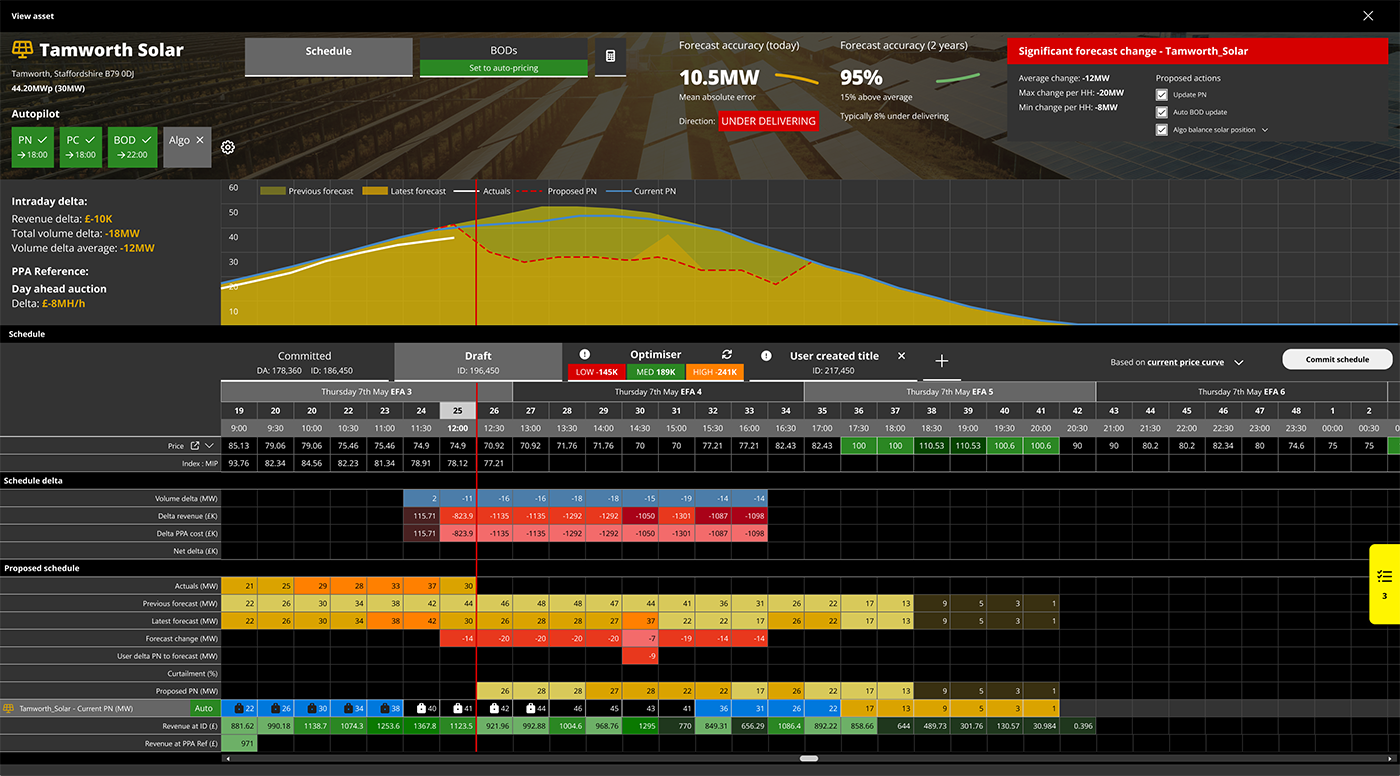
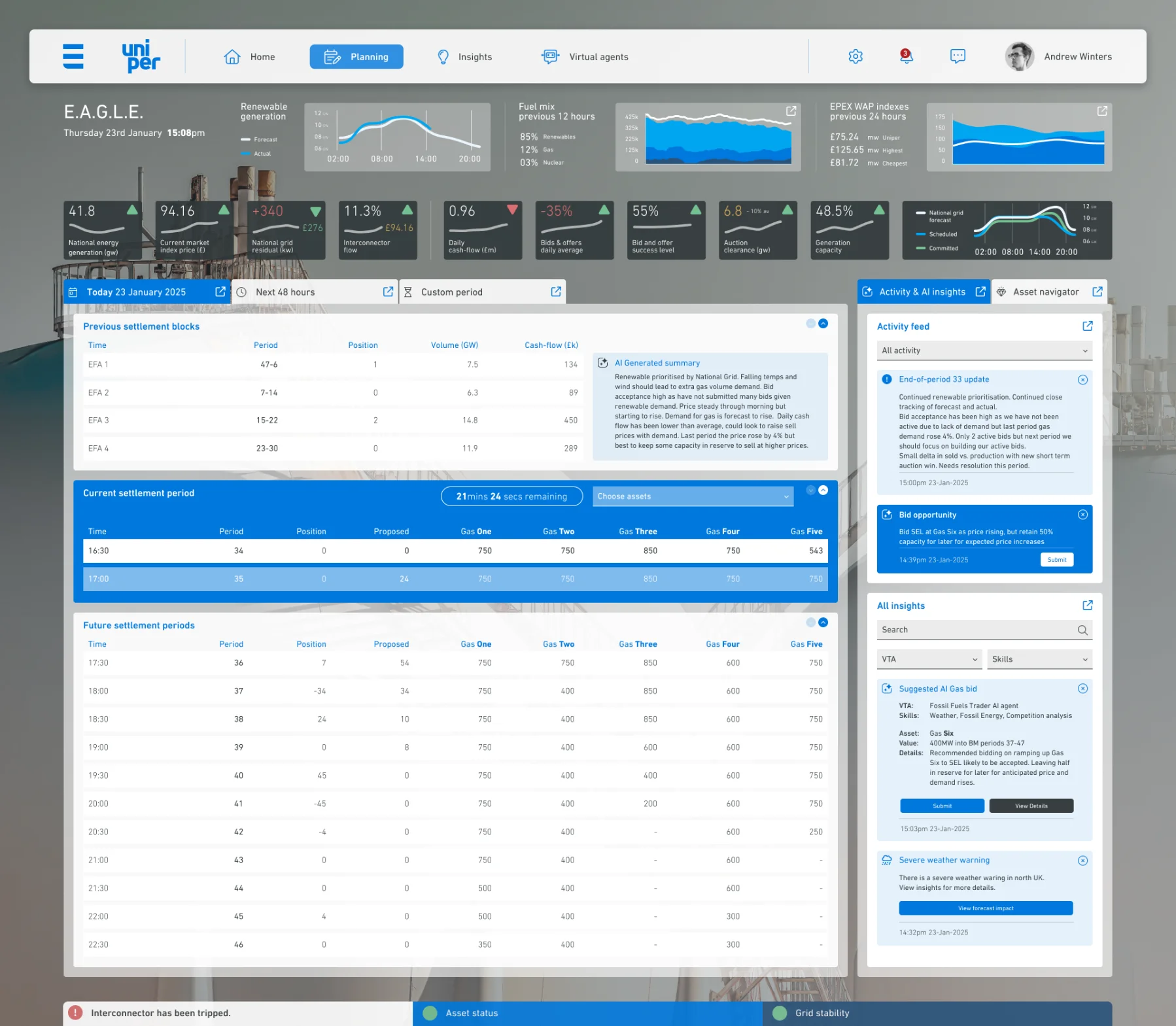
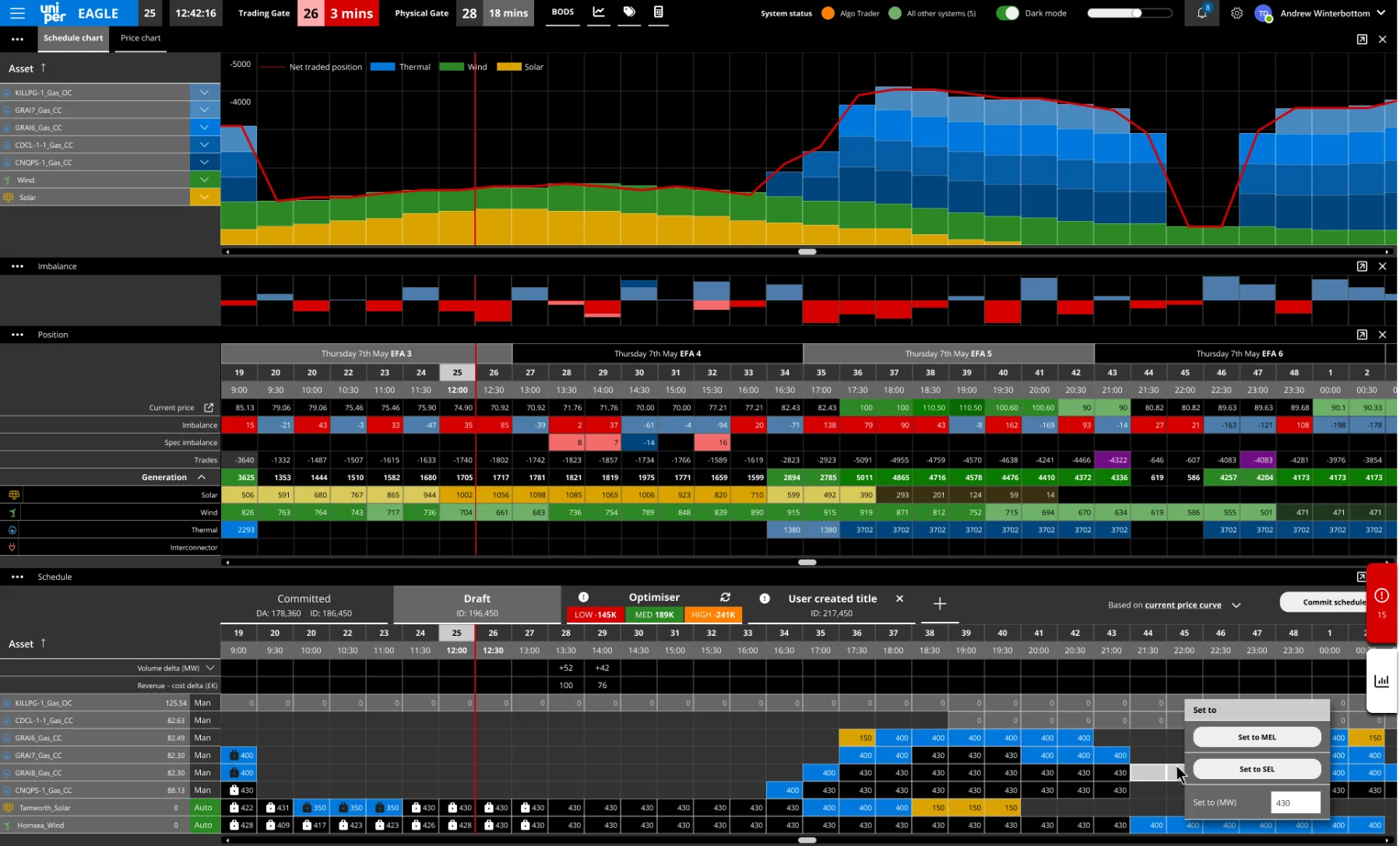
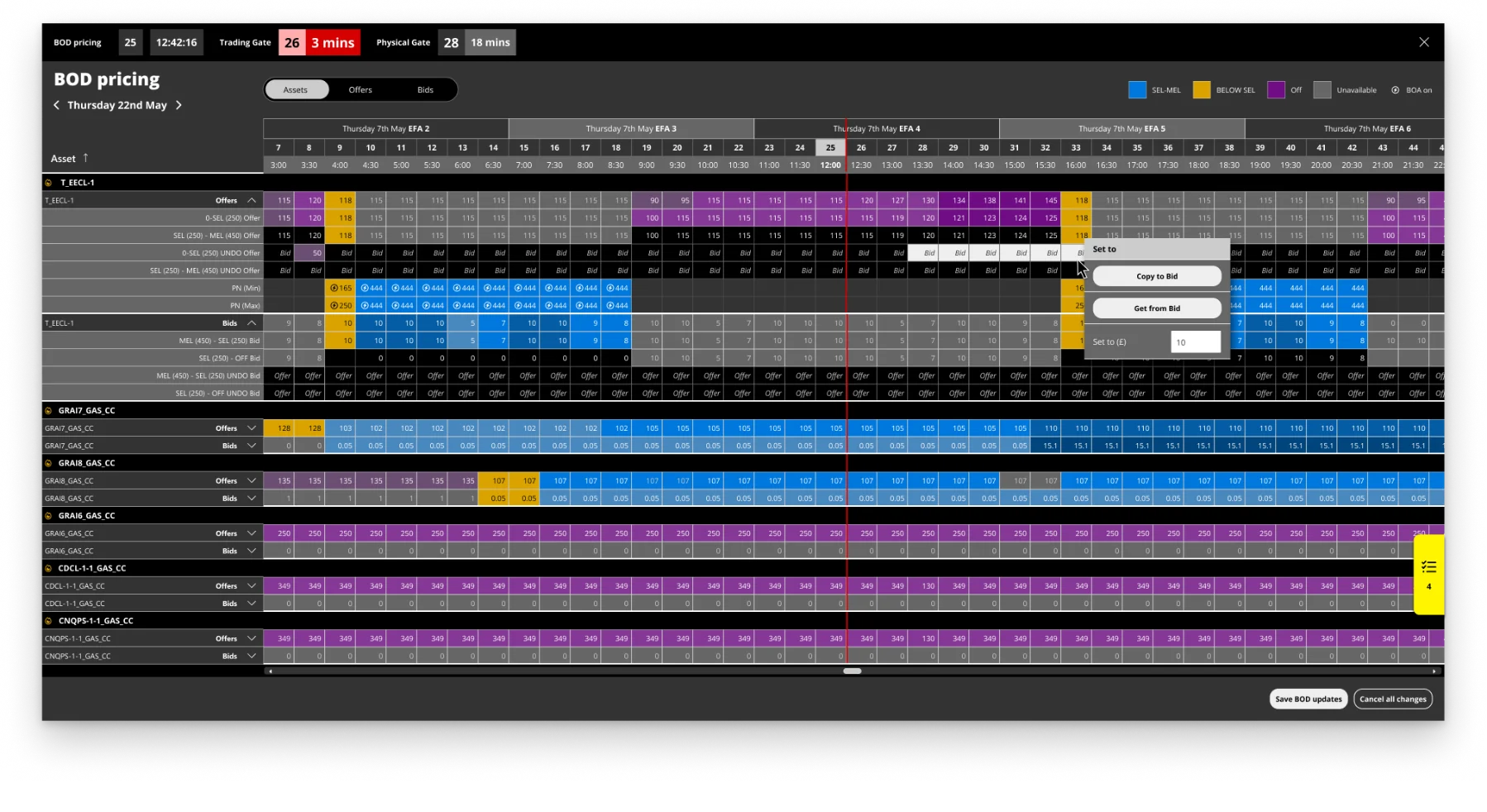
Design of a highly specialised trading application for energy traders to support day ahead planning of pre-sold energy and enabling dynamic selling and configuration of current day energy demands and grid balancing selling per half hour to National Grid. A data intensive experience designed to synchronise across multiple monitors within a 14-monitor control centre. Includes AI-based automation and trading suggestion capability.
This was phase one of reinventing Uniper's energy trading system. The platform I'm building on was originally delivered by Avanade back in 2010, and it's held up remarkably well. Fifteen years on, it still works, and in some respects it's still better than what a lot of other energy companies are running. But it was built for a different era of energy, and that's exactly the problem.
The old system was built for a world of gas power stations you can ramp up and leave running. That world doesn't really exist anymore. Renewable energy is fundamentally more demanding to trade, output constantly varies, so you can't just set it and forget it. Uniper's shift toward green power meant the manual way of working simply wasn't going to scale.
What wasn't working
- A large team carrying high operating costs, propping up an inflexible platform with UX and UI that was brilliant for 2010, not for 2025
- Fragmentation — traders constantly hopping between disconnected systems just to piece together a picture
- Limited integration between thermal power and renewable energy data streams
- Low confidence in the data — traders were working from point-in-time snapshots rather than real-time, which made them more risk-averse and slower to decide
- Heavy manual overhead — a lot of time going into note-taking and process maintenance rather than strategic thinking
- No room to experiment — there was no way to simulate a run before committing to it, no digital-twin-style thinking
If nothing changed, the risk wasn't dramatic failure, the old system still worked, it was money quietly left on the table: missed opportunities and slower, lower-confidence decisions, at exactly the moment renewables were making speed and confidence more important, not less.
I led from the first conversation. Before it was a contracted project, I worked with an Avanade energy account specialist and two-person design team (one UX designer and one visual designer) to build a vision as a sales exercise. That early vision looked nothing like what we ultimately designed, but it did its job: it gave Uniper enough confidence in our thinking and subject knowledge to bring us in.
From there, I owned
- Defining and selling the work: turning that initial vision into a proof-of-concept engagement, then writing the proposal (staffing, solutioning) that turned it into the fuller project
- All the research and design: running contextual inquiry on the trading floor, working directly with different trader types (day-ahead, current-day, forward planning), and translating what I learned into wireframes and visual design
- Handing it off well: once the design direction was established, I passed it to a design team to carry forward, so the work I'd validated could keep evolving
It was a small operation by design, just me and a brilliant business analyst, Tom Bowcutt, who kept everything grounded in real industry and data context, and provided invaluable innovative ideas around AI's use in automation as well as real life example data to populate the screens. A developer worked on the technical PoC.
Discover
We embedded ourselves next to the trading floor, in their office, working alongside the traders themselves. Through contextual inquiry, we watched how each type of trader actually worked (day-ahead, current-day, future trading and planning etc. each have distinct roles and needs) and talked through their pain points directly. Alongside that, we reviewed keys systems they were pulling data from, working out what was genuinely critical versus what could be summarised or automated away entirely.
Design
We ran on a Lean UX design thinking approach — Discover, Define, Ideate, Design, Prototype, Test — built around rapid prototyping and constant feedback rather than big upfront documentation.
We didn't just build click-through wireframe and visual prototypes. We also built technical prototypes that showed real data being ingested and AI actually generating suggestions and graphing insights, proving the concept, not just illustrating it. That combination is what built stakeholder confidence.
Three design principles ran through everything:
- Trade-centric: the experience is built around the trade, not the system
- All critical information in one place: no more system hopping
- AI-powered: customisable dashboards, instant alerts, and risk management tooling, all surfaced together
Branding took a deliberate back seat here. This is a data-dense, high-stakes environment, so the visual design prioritised usability and readability over brand expression, sticking to the palette, but letting colour do functional work rather than decorative work.
Deliver
This wasn't a design-then-test process, it was continuous. We didn't run formal sprints; we worked day to day and met with key stakeholders and traders every couple of days to get incremental feedback, evolving the functionality in near-real time. Tom's domain expertise was critical throughout, making sure what we designed reflected how the industry and their systems really worked. This is complex subject matter.
By the end this phase, the proof of concept and design had been approved and established, a more junior design team picked it up to keep building it out, and it's continuing to evolve today.
The proof of concept and design were presented to Uniper's executive team in Germany, and they greenlit further investment. It's now being considered as the trading platform for Uniper's operations across Europe, not just the UK.
Efficiency and cost
Automating manual data input and process maintenance should meaningfully lower operational costs and free traders from system hopping altogether.
Faster, more confident decisions
Moving from point-in-time to real-time data, backed by AI-generated insights, should let traders act faster and with more confidence than before.
A redefined role for the trader
Rather than manually building a single run scenario, AI now generates multiple options across different risk levels. The trader's role shifts from configuration to judgement — shaping AI suggestions using the kind of experience-based intuition (reading weather, anticipating demand events) that AI can't replicate. It's less about doing the manual work, more about applying human expertise where it matters most.
Simulation and experimentation
The new system introduces digital-twin-style simulation, something the old platform had no equivalent for, letting traders review likely outcomes before committing to a run, across both thermal and, increasingly, green power.
A radically simplified interface
The current-day trader's desk runs 14 screens. We've centralised what's critical from that sprawl into a coherent, usable set of two screens, a genuinely different experience from what existed before. The other screens still exist. It's just that their role becomes less critical and more contextual. The demand for context switching is reduced.
Strategic upside
By taking traders out of day-to-day system management, the business gets more room for strategic thinking and, critically, should capture more of the opportunities that were previously being missed, while supporting Uniper's move toward bringing more green power into the system.
What surprised me most was how informal this was in practice, not what I planned going in. It ran less like a structured project and more like — come into our office, talk to our people, design with us. There were formal review touchpoints, but the day-to-day was casual and fast-moving, and that's exactly what let us reach a trusted outcome quickly as partners.
Six months, really 2.5 intensive months of core design work, is not a lot of time to get to grips with the complexity of energy trading, especially when the knowledge isn't documented anywhere and lives in people's heads. Tom was essential here; without his ability to keep the design anchored to real business needs and industry standards, this wouldn't have worked.
This project shows the importance of maintaining expert human involvement in processes which are rapidly being automated via AI. This project allowed the highly skilled human operators to have a much more strategically important role, where AI takes care of all of the complex integrations, analysis, reporting, and note-taking. The humans use their expertise to make calls on which suggestions are most likely to work and monitor ongoing performance without being distracted by processes and manual tasks.
More than anything, this project reinforced for me how powerful the combination of design expertise plus subject matter expertise, applied directly with the customer in an agile way, can be. It's led to substantial ongoing work and, potentially, a genuinely ground-breaking, AI-driven trading system for Uniper.