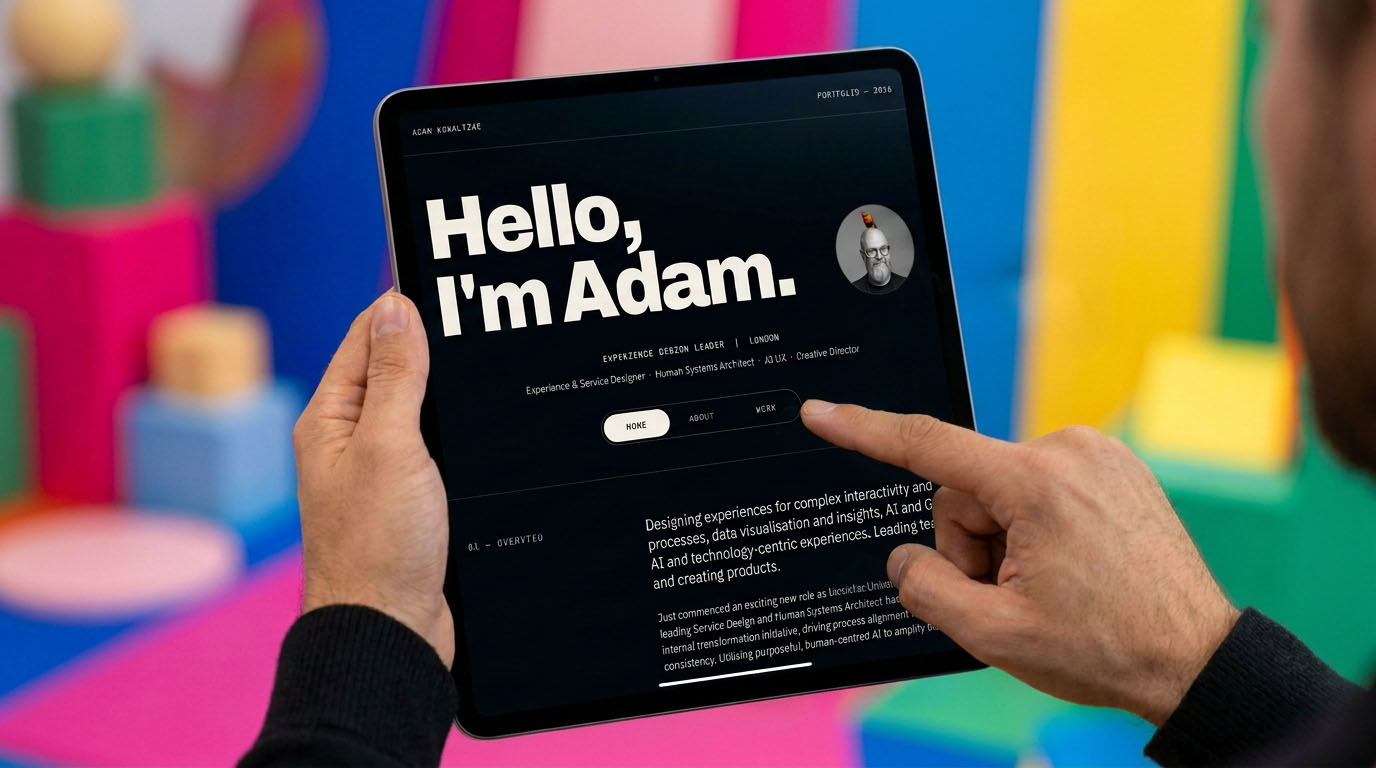
I've been thinking about how my career has drifted, from visual design, through UX to service design, and now toward Human Systems Architecture (HSA). AI keeps getting better at the doing: the wireframing, the designing itself. What's left for someone like me is strategy and orchestration - figuring out how humans and AI actually work best together, to amplify each other’s talents. I view HSA through a service design lens, but you don't need to be a designer to do it well although the methods are very close at times.
I decided to test out the latest AI design capabilities on something small: my own portfolio site, redesigned and rebuilt over the last couple of weeks. www.kowaltzke.com I’m not looking for work, love my current role, but just felt like a needed some pure design work.
The bit I always avoided is writing up case studies. Working quickly in consulting, you never get time to consolidate anything, it all gets thrown into directories, and you rarely sit down and debrief, even though you should. By the time you're trying to tell the story of what you did, you're left with disconnected documents and fading memories.
So instead of writing them myself, I built a structure for a case study template, pulled together the core few assets for each project, and fed Claude the template so it could pull out what was relevant from the files. Then I set Claude up as an interviewer, gave it objectives, and told it where to push to get an answer or move on if I'd forgotten the details. It surprisingly went further than I'd briefed it to, off its own back, which genuinely impressed me. It’s a great interviewer, providing motivational feedback as it goes! Talking through what I knew, it asked questions until it had enough, then wrote the case studies up. I went back and added what I'd forgotten, but the drafts were close to right first time. I also fed it my tone of voice, built from my own writing and emails, so it read like me telling the story, not something generated. Obviously I checked and rewrote the parts I felt could be better, more ‘me’ or less boastful. AI can oversell you! That’s human experience at work in the finessing.
For the design, I built something simple and quick in Figma first, but it wasn't what I wanted - too plain, too time consuming for after hours 'hobbying'. So I moved to Claude Design, put it on Fable to test their best, and gave it specific direction on how I wanted the site to look, the animations, the typography, fonts and colours. It came back remarkably close, and a few rounds of tweaks got the small but important things right - how elements animate in, font sizes it had made too small etc. Little tweaks that make the difference and more interactive than I'd have managed in Figma alone.
The edit experience is close enough to Figma that much of the design tweak work happens in the tool manually. I built the homepage first, then About, then Work, then the case study pages, tweaking then repeating page templates as I went – another one of these but with this text…. Design work cost about £50 all up using Fable (set to medium).
At that point I thought I was done, until I noticed the exported HTML version comes out as giant HTML page files with encoded images within. So I got Claude Design to package the assets and write a README for Claude Code to take over. I'd never used Claude Code, no IDE on my machine. Instead I did it all through Terminal which is a weird old-school experience. About eighteen minutes later, the site was finished, matched pixel for pixel against screen captures Claude Design had taken on export. Couple of errors but nothing a couple of prompts couldn't fix in minutes.
The design wasn't responsive by default, but asking Claude Design to use standard breakpoints fixed that and Claude Code kept them in place.
I can't vouch for whether the code would hold up on an enterprise site, but for a portfolio site I'm more than pleased: sensible file sizes, fast load times, animations close to intended. It reinforced that the critical part of what I did as a UX designer hasn't gone anywhere - the strategy, story, structure, information architecture and the narrative. That's still entirely human. What's changed is how fast it can now come together. I’m sure it’s not perfect (I have forgotten at least two links on the homepage!) but it’s seriously close to perfect.
Handing over files and telling Claude to simply build the site without human input would have been faster, but it wouldn't have felt like me or carried the same authenticity or narrative. This matters greatly. Interviewing users using AI is a great ‘humanise’ method to add context and narrative around notes and summaries. Speaking directly to the computer using Wispr Flow (can’t live without that tool!) Writing case studies is a most painful task I used to put off, but using AI as an interviewer, sparing me the analysis and note-taking from source decks, made a real difference. I could complete all the case studies in just a couple of days in the evenings. I've written more than I put online it's so fast, but they're good because the capture process is a perfect combination of AI with human expertise and knowledge (just like a good HSA eh!)
I do miss design, if I'm honest, and I could well end up back in it one day. But right now the real focus is working out how humans and AI combine and amplify quality, producing things that are genuinely useful and still feel authentically made, not just generated or impersonal. I will get it into Figma, set up a design system, but for now, one cool new website finished (enough), better than I thought I needed it to be.